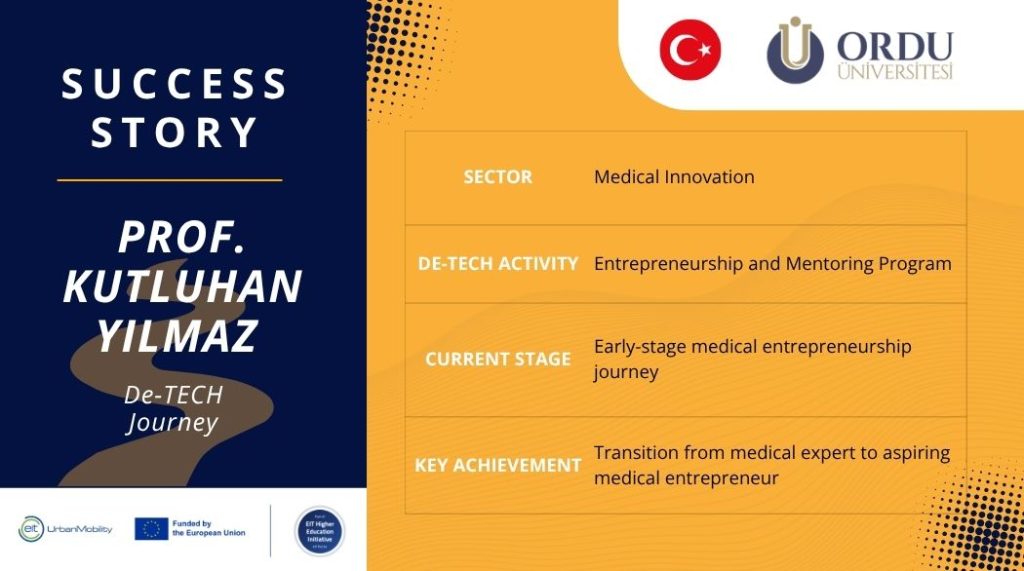
From paediatric neurology to medical entrepreneurship, Professor Kutluhan Yılmaz’s journey with De-TECH illustrates how entrepreneurial training can help researchers and healthcare professionals explore new ways of translating their expertise into practical solutions.


Through the EIT Higher Education Initiative-funded programme, Professor Yılmaz complemented his clinical and academic experience with practical tools in needs analysis, product–market fit, intellectual property and business development. His experience shows how structured training and mentoring can provide researchers with the knowledge, confidence and perspective needed to take the first steps towards turning a research-based idea into an entrepreneurial initiative.


By joining the De-TECH Venture Builder Competition, LIGARO strengthened its entrepreneurial capabilities, refined its business case and received support to accelerate the development of its innovative bio-based wood glue.

About

Professor Kutluhan Yılmaz is a Turkish physician and academic specialising in paediatric neurology, paediatrics and sleep disorders. He is affiliated with the Faculty of Medicine at Ordu University in Türkiye, where he combines clinical practice, research and university teaching. With extensive experience in child health and neurological conditions, Professor Yılmaz joined the entrepreneurship training programme delivered through WP5 of the De-TECH project.

His participation reflects the interest of experienced researchers and healthcare professionals in complementing their scientific expertise with entrepreneurial skills and exploring how research-based knowledge can be transformed into innovative solutions with practical value for patients and healthcare systems.

The Challenge

Professor Kutluhan Yılmaz joined the De-TECH Entrepreneurship Training and Mentoring Programme to explore how his medical and academic expertise could become an entrepreneurial initiative.

As an experienced physician, researcher and university professor with a demanding schedule, he needed practical guidance to understand how to develop and validate a healthcare-related business idea.

The programme allowed him to complement his scientific knowledge with entrepreneurial skills, learn from experienced trainers and mentors, and explore new ways of creating impact beyond his clinical and academic work.

Despite his busy schedule, he participated actively and found the experience particularly inspiring in the field of medical entrepreneurship. The training increased his motivation and confidence to move forward with his idea.

The De-TECH Journey

Through De-TECH, funded by the EIT Higher Education Initiative, Professor Yılmaz gained access to entrepreneurship training and mentoring designed to help researchers and professionals transform knowledge into viable business ideas.

The programme provided a structured pathway for exploring medical entrepreneurship, combining practical learning with guidance from trainers, mentors and experts from different European innovation ecosystems.

Key modules on needs analysis, product–market fit and intellectual property rights helped him examine his idea from both a healthcare and business perspective. These sessions enabled him to better understand potential users, assess market needs and consider how to protect and develop the knowledge behind his future solution. Finally, the programme also gave him an international environment in which to exchange ideas and learn from other participants’ experiences.

Impact & Results

The key milestone was Professor Yılmaz’s successful completion of the De-TECH Entrepreneurship Training and Mentoring Programme and his ability to apply the knowledge gained to his own medical business idea. Building on his extensive expertise in paediatric health, he developed a stronger understanding of how to translate specialist knowledge into an entrepreneurial initiative.

The Modules covering product–market fit, needs analysis and intellectual property rights helped him assess the relevance of his idea, identify potential users and consider how its value and underlying knowledge could be protected.

Through the programme, he moved from a general ambition to pursue medical entrepreneurship towards a more structured business concept and clearer next steps. Although his startup remains at an early stage, he has gained the practical knowledge, motivation and confidence needed to continue its development and take the first concrete steps towards bringing his idea to life.

Professor Yılmaz’s experience illustrates how the EIT Higher Education Initiative supports researchers and professionals in developing the skills and confidence needed to become entrepreneurs. Through De-TECH, he complemented his medical and academic expertise with practical knowledge of needs analysis, product–market fit and intellectual property rights.
The programme has encouraged him to explore how his expertise in paediatric health could be transformed into an innovative solution with practical value. In the longer term, this journey could contribute to healthcare innovation by connecting clinical knowledge with entrepreneurial approaches.

" Participating in the DE-TECH Entrepreneurship Training and Mentorship Program has been an extremely valuable and fulfilling experience for me. As a medical professional, my main purpose in participating in the program was to explore the concepts, methods, and practices in the fields of entrepreneurship and innovation and to determine what I could adapt and apply to my field of expertise. In this respect, I can say that the program met my expectations and provided me with new perspectives that I can transfer to my field. Topics such as idea and technology valuation, market validation, Product-Market Fit, and QFD analysis helped me better understand that an idea should be systematically evaluated, not only in terms of innovation, but also in terms of whether it responds to a real need and is viable. Especially customer journey and needs analysis sessions; I think it has a significant application potential in the field of healthcare in terms of addressing the needs of patients, students, healthcare professionals, and other stakeholders in a more structured way. The sessions on financial modeling and funding, scaling and governance, and intellectual property rights and strategy also gave me a different perspective on the sustainability and feasibility of innovative projects in the field of healthcare. The pitching and entrepreneurship communication training was also very useful in showing that it is not enough to develop an idea alone; it is equally important to present this idea in a clear, persuasive and well-structured way. The practice-oriented nature of the training, the mentoring process and the opportunity to interact with participants from different disciplines and countries were among the other important strengths of the program. In fact, I participated in this program as a specialist physician and academic staff, and one of my main expectations was that the program would offer content and applied approaches that I could adapt to my own professional field. I think that the program has provided me with concrete knowledge and approaches in this respect. As someone who participated in the program for this special purpose, I am very pleased to have gained valuable gains regarding the interdisciplinary transfer and adaptation opportunities I was looking for. I would like to thank everyone who contributed to the program, especially the trainers and organizers”. Prof. Kutluhan Yilmaz
Tim Gatz
Team Member, Product Development